
At last, an economic policy we can all get behind – doubling the royal family’s funding

But with rumours about a certain workshy Windsor circulating this week, are we actually encouraging joblessness with an overly generous safety net?
https://www.theguardian.com/commentisfree/2026/jun/26/economic-policy-royal-family-funding-windsor
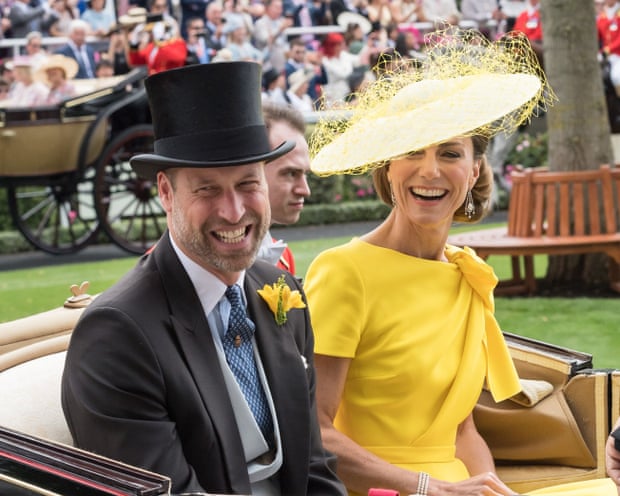
Finally, some part of our struggling state is getting a massive budget increase – and it’s not even the welfare bill, like normal. Or maybe it is? The monarchy’s core funding is going to double to £100m. Also mentioned under cover of the same info dump is the fact that the refurbishment of Buckingham Palace is currently coming in at £369m, but the King and Queen don’t want to live there when it’s done.
Personally, I’m a big fan of the gaiety the Windsors add to this nation, willingly or otherwise, but I do worry: are we enabling a culture of dependence that isn’t actually great for any of the people involved? Does the royal economy need rebalancing, if it is simply impossible to own an absolutely vast private network of land and high-end properties without somehow still needing a top-up from the state? You’ve heard of the poverty trap – will no one think of the royalty trap?
Maybe the Windsors would argue their sovereign grant counts as “in-work benefits”, given their royal duties. But looking at some numbers circulated by the former MP Norman Baker this week, one has to wonder if we are actually discouraging work with an overly generous safety net. According to Baker’s research, Prince William has done 57 royal engagements so far this year, which doesn’t feel like the shift we might expect from an able-bodied – if mental-health-obsessed – 44-year-old man, while the King, who is 77 and has cancer, has done 76. Princess Anne is beating the pack yet again with 100. She’d be fine, but by rights William would have quite a sticky call with his Jobcentre Plus work coach, and would be more likely to pick up a sanction than a doubling of benefits.
I appreciate that in the summer months in particular, there is a flood of migrant royals to this country and they very ostentatiously just do nothing. It must be galling for William to have to get up on a couple of mornings a week and trudge towards a ribbon to cut, while some arsehole foreign prince is just lying in bed till noon before revving a Bugatti round Mayfair then mooching back to the hotel to carry out a couple of sexual assaults. I get it. The perception of unfairness matters, and many royals feel it keenly. I remember reading the tech author Evgeny Morozov describing a scene his literary agent had allegedly witnessed in Jeffrey Epstein’s mansion, where the then Prince Andrew and his sex case friend were getting foot massages from a couple of Russian girls. Andrew was complaining how other royals had it so much better than him. “In Monaco,” he reportedly said, “Albert works 12 hours a day, but at 9pm, when he goes out, he does whatever he wants, and nobody cares. But, if I do it, I’m in big trouble.”
I know what you’re thinking – wait: when did this waste of space ever do a 12-hour week, let alone a 12-hour day? But set your eyerolls aside. The politics of envy benefits no one. Andrew was big on how vital it is to encourage enterprise. In this case, an international sex trafficking enterprise (unknowingly, according to his denial) – but I think we’re supposed to get the point.
As I say, William talks a lot about mental health, so it’s possible he’s one of the 1.3 million and rising working-age adults with limited or no capacity to work for mental health reasons. Yet work brings so many benefits, from dignity to purpose to being able to buy your own stuff, and I worry that William could be ushering in a turbocharged era of intergenerational dependence, where the royals become people who don’t really work because they didn’t see their parents doing it. Then again, it’s perfectly possible that William does work more than that engagement tally indicates, only for himself, rather than the nation. Some say he has deprioritised public engagements in favour of boosting his private finances. After all, he is not – how to put this? – economically inactive, because the other revelation this week is that he paid £7.76m in tax last year, after an entirely opaque number of deductions. The King paid £12.9m, which, reports inform us, places him in the top 100 UK taxpayers.
(Sidebar: that glimpse of the surprisingly little it takes, in the context of the super-rich, to be in the top 100 taxpayers tells its own story. Every time I read a stat like that I wish to offer a personal note of thanks to every chancellor, Labour and Conservative, who ballooned Britain’s tax code to a ludicrous 23,000-plus pages – the longest in the world – and made it a charter for avoidance at the highest levels. All of this was a choice, made by successive chancellors, and whether they understood the choice they were making – you’d hope they did, given their job – the outcome is the same. Many more big-hitters get around it.)
Anyway, back to the main event. The royal family are treated as a sort of zero-sum game, a brand asset so valuable to the nation that almost any crazy price hike ought to be approved because of soft power and tourism and whatnot. And yet, I can’t help feeling you could very much have the soft power and the tourism and the whatnot with a somewhat less outrageous funding model. Not to be vulgar, but how does Charles’s “slimmed down” monarchy now seem to cost twice what the bloated one did?
Marina Hyde’s new book, What a Time to Be Alive!, is out in September (Guardian Faber Publishing, £20). To support the Guardian, order your signed copy at guardianbookshop.com.


Three years after his death, the Met goes after Mohamed Al Fayed. As for his enablers – well, you can’t rush things, can you?
The crimes he stands accused of required whole armies of facilitators. Don’t the victims deserve to see them face justice too?
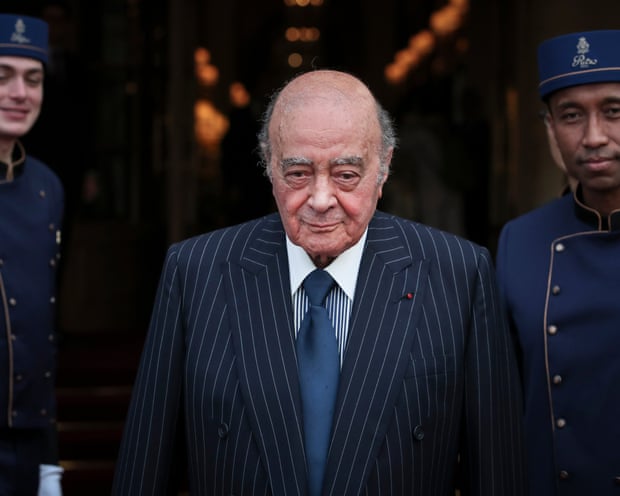
How reassuring to learn that police investigating claims of sexual assault against Mohamed Al Fayed have handed a file to the Crown Prosecution Service, a mere three years after the former Harrods owner’s death at the age of 94, and just decades after the first survivors made reports of abuse. The CPS has said it won’t provide a timescale for any decision, to which we might remark: no shit. With this case, the one thing you could never accuse any of the authorities of is being bound by anything approaching a timescale.
The story does, however, certainly have scale. So far, more than 400 allegations including rape, sexual assault, sexual exploitation and human trafficking have been made against Al Fayed by at least 156 women – abuse he got away with, having died without any charges ever being brought against him. The claims span the years 1977 to 2014. At least 21 women came forward while he was alive, and there have been extraordinary rundowns in news articles and documentaries about all the alleged enablers of his wicked behaviour, from lawyers to mouthpieces to security henchmen to the doctors who carried out “purity examinations” on his young female PAs.
So, not to be a Debbie Downer – because any movement on this case is better than none – but perhaps that sense of scale is not immediately discernible from the file that has been sent to the CPS, which relates to a male suspect in his 80s and two indecent assaults on two women in London. The investigation remains ongoing, the Met confirms.

Of course, other under-prosecuted criminal networks are available. During the full-spectrum coverage of the Jeffrey Epstein case, many asked how on earth so many blind eyes could be turned by so many people to so much flagrant abuse by someone who was known to have served prison time for soliciting prostitution from a minor. People marvelled at the vast collective silence – yet anyone who couldn’t quite believe how it could happen should have been reassured that other vast collective silences were very much ongoing. Peter Mandelson’s now notorious message of commiseration to his friend Jeffrey shortly before his 2008 incarceration – “it just could not happen in Britain” – always seems to me ironically resonant. Perhaps his lordship was right, though not in the way he meant.
As the Epstein furore raged on earlier this year, several Al Fayed survivors wrote to me asking why this one case was dominating everything while another, still unresolved one – and so much closer to home – seemed to lack the turbocharge of outrage that pushes something from the places our society would rather forget into the ones where we have our (always belated) reckonings. The answer to that question is normally that significant numbers of people and institutions have a deeply vested interest in not getting to the bottom of it.
It would feel unwise to conclude anything other than that in this case. There has been no equivalent political pressure to let daylight in on Al Fayed’s activities. No one has got wall-to-wall news coverage for asking how he was able to operate an alleged criminal fiefdom in the centre of Knightsbridge, when allegations were repeatedly made and the rumours in rarefied circles were more than deafening. It was, it seems, just the way things were.
And as indicated, for things to be that way for so long, there needed to be whole armies of enablers and hangers-on who facilitated abuse, or looked away, or closed down or ridiculed or trashed those who stepped out of line and said anything about it, including the alleged victims. Only one of Epstein’s helpers, Ghislaine Maxwell, has ever been brought to justice. Typically, no one bar the kingpin in what I think of as the sex-case industrial complex even faces so much as a charge – they simply melt back into society, into other jobs, into the ongoing conspiracy of silence.
Today, the Al Fayed survivors’ group Justice for Fayed and Harrods Survivors issued a statement pointing out that: “Survivors have spent decades either not being believed or being told that Fayed and those around him were too powerful and that nothing could be done – but today is an important reminder that the passage of time does not, by itself, put accountability beyond reach.” Yet with the best will in the world, the passage of time doesn’t exactly help, does it? Al Fayed himself died unscathed, and we all know that once things tip conveniently into the “historical” file, they are so much harder to prove.
But there are things the public can get behind right now. What Al Fayed’s survivors want is the trafficking investigation they have been requesting for almost two years. As they point out, this was not one bad man, nor some form of corporate abuse. It was, they allege, a trafficking network involving multiple perpetrators and enablers and backed by the global movement of illicit funds. At least five survivors have already been confirmed by the Home Office as victims of modern slavery. Yet the Met has been accused of having failed in its legal duty to offer the victims a referral to the national referral mechanism (it’s understood the police didn’t believe they were obligated to), which identifies modern slavery victims. Yet again, all the running is being made by a survivors’ group. No One Above wants confirmation that human trafficking and modern slavery are the primary framework of the Al Fayed investigation, and to know that financial investigators are being utilised to determine how the network was funded and concealed.




It’s a truly Trumpian tragedy: he’s made billions of dollars but can’t buy love or respect

Potus pocketed over $2.2bn last year – but with an algae-filled reflecting pool and his State Fair a fiasco, what price happiness?
From certain angles, it might appear as if President Trump is having a tough month. He messed up the renovation of the Lincoln Memorial reflecting pool, which he blamed on acts of vandalism no one has been able to stand up. The supreme court rejected both his bid to appeal against the $5m (£3.8m) civil judgment against him for defaming and sexually abusing E Jean Carroll, and his executive order to end birthright citizenship. And the war with Iran keeps rumbling on. And yet, after Trump’s mandatory financial disclosure report was released on Tuesday, headlines drew attention to the fact the president made more than $2.2bn in revenue in 2025 – more than three times what he pulled in the year before his inauguration. Contrary to appearances, perhaps everything is going exactly to plan.
It is always a question with Trump as to how much the wealth he has accrued in his second term in office is the spoils of strategy rather than the lucky result of his scattergun but industrial-scale hustle. Looking at the numbers in his financial report, one is reminded that before he became president, Trump piloted a series of failed businesses – six of which declared bankruptcy – and gave every indication of being a lousy businessman. It’s often pointed out that if Trump had simply invested the vast inheritance left to him by Fred Trump, his father, in a standard tracker fund, he would’ve made more money than through his lacklustre business career, and there’s nothing to suggest this was likely to change.
That was before his second presidency, of course. Now he and his children are sitting on top of a huge fortune, large parts of which seem to have come from sources with interests in sucking up to the president. As the New York Times points out, a large chunk of Trump’s $2.2bn windfall last year came from an investment firm with ties to the United Arab Emirates, which bought an almost 50% stake in his crypto company, World Liberty Financial, and which is part of an industry over which Trump has policy-making and regulatory influence.
Similarly, the report registers the smaller but still significant revenue streams generated by Trump’s side hustle in defamation and other lawsuits, including settlements with ABC ($16m), Meta ($24.5m) and Paramount ($16m) – legal proceedings which, it seems fair to assume, these media and tech companies may have had more appetite for fighting had the plaintiff not been the president of the United States with vast influence over their industries.
All of which leaves Trump in the strange position of, on the one hand, getting the thing he has always desperately wanted in life – genuine, unimaginable wealth – at a cost of the other thing he has always desperately wanted in life, universal admiration and applause. This trade-off is so morally neat it might’ve come from a fable, but that is where the US president currently finds himself. Rich but mocked; successful, if you look at his income, but an absolute turkey of a leader with a 39% approval rating and an image so tarnished that even Giorgia Meloni, the unpopular rightwing leader of Italy and former absolute lickspittle to Trump, has felt emboldened to have a crack.
As with most petulant personalities, it’s likely to be the small failures that niggle most with Trump. While his famous deal-making abilities continue to field poor results in the Middle East, the president seems to have turned himself inside out trying to explain away the algae currently blooming in the Lincoln Memorial reflecting pool. It’s a tiny, irrelevant failure as these things go, but with optics so bad, so glaringly unmissable even to those with no interest in Iran – here is a man who can’t even keep the nation’s pond clean – he’s had to drum up endless wild stories to excuse it.
Likewise, Trump’s predictably terrible oversight of something called the Great American State Fair. You’ve probably not even heard of it, despite the fact it is going on right now on the National Mall in Washington DC, and has been advertised by the White House as a 16-day extravaganza to mark the country’s 250th birthday with “a world-class exposition”. Or, as it turns out, with an empty food hall, unpeopled exhibitions and television’s Dr Oz addressing a half-empty field in a setup that looks dodgier than that so-bad-it-became-an-instant-classic Willy Wonka experience in Glasgow.
It’s Trump’s reverse Midas touch, of course, which wrecks everything he touches outside his family’s crypto holdings and which, as support for him wanes even in his former strongholds, must be tearing his ego, divided as it is between the primary motivations of money and praise, clean in two. If only he were a character from fiction – an Elizabethan tragedy, say, or an episode of Captain Underpants – it would be fascinating and grimly hilarious to watch this play out.


Football, golf … behold the future of world sport: Donald Trump as referee-in-chief
After his dubious intervention at the World Cup, the president is now an arbiter of high-level fairway disputes. There’s one word for that: SAD!
For so many of us around the world, the final scenes of the World Cup were a chance to switch off the TV with an eye-roll and observe mildly: “Well, I think that’s quite enough America for us all for a while now.” And yet: there can and must always be more. It is simply the way of things. If you thought the World Cup being carried on to the pitch ahead of Sunday’s final in some kind of Louis Vuitton sex trunk was the nadir of hysterical trashiness in sport, then simply recall the lesson of the past few years and expand your mind. It can always get trashier.
To the parched fairways of Royal Birkdale, then, the host of this year’s Open Championship, which – yesssssss! – was won by someone other than Bryson DeChambeau or Scottie Scheffler or any of the other radioactively ghastly US golfers you’d cheerfully head-flush in a Mar-a-Lago loo just as long as you could clear the classified documents out of it first. It has now been revealed that, during his heated row over a two-shot penalty he was handed for improving the area for his backswing, DeChambeau has been accused of threatening to call the US president unless it was all resolved in his favour. To repeat: threatening to call Donald Trump.

If you missed this, DeChambeau picked up the penalty for improving the line of his swing, apparently having trodden down some long grass close to his ball on the fifth hole during the second round last Friday. He publicly lost his mind about it, demanded to be driven back to the scene with officials, then returned to the tournament scoring area and reportedly threatened to call Trump. Has a new portal to the dark side opened in sport? Given Trump’s known intervention in the World Cup (of which more shortly), who among us would bet against it?
At time of writing, I had read everything about this sensational escalation, but I still don’t know nearly enough about it. I need every detail. I need everyone involved to reconstruct the entire conversation. I want to know exactly how quickly you might go from “no way did I do any gardening” to “fuck you – patch in the president”. This is a new era of American pant-wetting and I need to understand absolutely everything about its conventions.
Certainly, all I already thought about Bryson DeChambeau has been magnified. If you’re unfamiliar with his work, as well as being a two-time US Open champion, Bryson is a hardcore Mar-a-Lago steak-gobbler who got a shout-out in Trump’s 2024 election victory address, though that was delivered at the Palm Beach Convention Center and not at the latter’s Floridian golf-club residence. (Even so, every time we see those words, the hilarity should strike us anew. The president of the United States of America lives in a golf club. Honestly: I just CAN’T.) Anyway, in the small hours after his victory over Kamala Harris, Trump was very keen to pluck DeChambeau from the sliders queue or the ormolu urinals or wherever and get him up on stage. “Bryson DeChambeau is up here somewhere,” Trump told the cameras. “What happened to Bryson? Where is he? Bryson! He’s hitting balls. He’s on the way?” Eventually, DeChambeau realised there was nothing for it but to climb awkwardly on to the stage.

And yet, where is your orange god now, Bryson? Where was he on Friday, as you seemingly failed to summon him to a faraway British links course having been observed doing a bit of landscaping?
There seems, at present, to be no evidence that Bryson put the call in, and since he flaked out of all media appearances for the tournament, no one has been able to ask if he contacted the president in any other way. We understand, however, that he asked for Trump to be called. Sad. Perhaps the only thing worse than demanding that the president be called over you dicking around with the grass is not having the president called over you dicking around with the grass. And then realising that, in many ways, you got less off Trump than some guy called Folarin Balogun who plays a sport called … hang on, let me get my lorgnette … “soccer”. That would be a lot of perspective for Bryson to absorb on a Friday lunchtime.
The maddest thing about the entire revelation is what it says about how comically debased and politicised sport has been in such short order. Because the thing is, you can totally see it. You can genuinely imagine that the only situation room Trump wouldn’t lose focus in after about 10 minutes is one where he was required to cheat remotely at golf. You can just picture him assembling Pete Hegseth and Marco Rubio and all the other guys with the too-big shoes in the White House situation room, and them huddling round a feed like the photo of the Obama administration watching the Seal team raid that got Osama bin Laden. Only this one is coming from a grass-level camera at Royal Birkdale.


NOW:


A.I.-Generated Contextual Essays:
+-----------------------------------------------------------------------------------+

|                            THE DOUBLE STANDARD OF THE STATE                       |
+-----------------------------------------------------------------------------------+

|      ORDINARY CITIZENS                             GOVERNMENT OFFICIALS           |
|  - Micro-managed by shifting bylaws.            - Shielded by institutional walls.|
|  - Faced with heavy fines ($250-$500).          - Public funds used to hide facts.|
|  - Criminalized for everyday transit.           - Absolute impunity for violations.|
+-----------------------------------------------------------------------------------+
- The absolute removal of bureaucratic shields that protect public officials from transparency.
- The stripping of arbitrary powers from unelected municipal and provincial boards.
- The re-centering of governance strictly onto core infrastructural obligations.
+-----------------------------------------------------------------------------------+

|                     THE PYRAMID OF INTENTIONAL INSTITUTIONAL BLINDNESS             |
+-----------------------------------------------------------------------------------+

|               [ ELITE LEVEL ]                                                     |
|               - Total Legal Impunity                                              |
|               - Access to Public/Private Funding Tops-ups                         |
|               - Protection by Transnational Legal Shields                         |
|                                                                                   |
|         [ ENABLER & INSTITUTIONAL LEVEL ]                                         |
|         - Systematic Silence / "Always Again" Cover-ups                           |
|         - Weaponization of Public Budgets to Conceal Crimes                       |
|         - Deliberate Failure to Track Trafficking/Exploitation                    |
|                                                                                   |
|   [ CIVIC & DOMESTIC LEVEL (THE CITIZENRY) ]                                      |
|   - Micromanaged by Constant, Fabricated Bylaw Adjustments                        |
|   - Targeted with Predatory Revenue Fines ($250-$500)                             |
|   - Criminalized for Seeking Basic Autonomy and Joy                               |
+-----------------------------------------------------------------------------------+
+----------------------------------------------------------------------------------+

|                    THE CHRONOLOGY OF ASYMMETRIC STATE ACTION                     |
+----------------------------------------------------------------------------------+

| TIME FRAME | ELITE LEVEL INTERVENTION              | DOMESTIC / CIVIC HARASSMENT |
+------------+---------------------------------------+-----------------------------+

| MULTI-     | Transnational trafficking networks     | Constant, predatory updates |
| DECADE     | actively shielded by institutional    | to local codes to criminal- |
| CYCLE      | silence and public legal funds.       | ize basic tools of transit. |
+------------+---------------------------------------+-----------------------------+

| IMMEDIATE  | Executive power directly deployed to  | Sudden retroactive bylaw    |
| IMPACT     | protect cabinet ministers or shift    | bans enacted days after an  |
|            | international regulatory decisions.   | ordinary family purchase.   |
+----------------------------------------------------------------------------------+
- The Mirror Effect: The manipulative or low-vibrational individual stands fundamentally "twixed" and confused when faced with an authentic, unyielding presence. They cannot comprehend a life anchored in true, uncompromised individuality or a capacity for higher love.
- The Study of Movements: Because they operate entirely on a fractured, superficial plane, they obsessively study the sovereign individual’s movements, desperately trying to reverse-engineer the source of their peace, light, and natural authority.
- The Projection of Invisibility: Faced with an internal truth they can neither mimic nor destroy, they succumb to bitter envy, feeling completely "invisible" and reduced to "chop liver" in the presence of an unvarnished mirror.

.png)


!.png)


👉 Dajjal's Fraudulent System/ Reality